
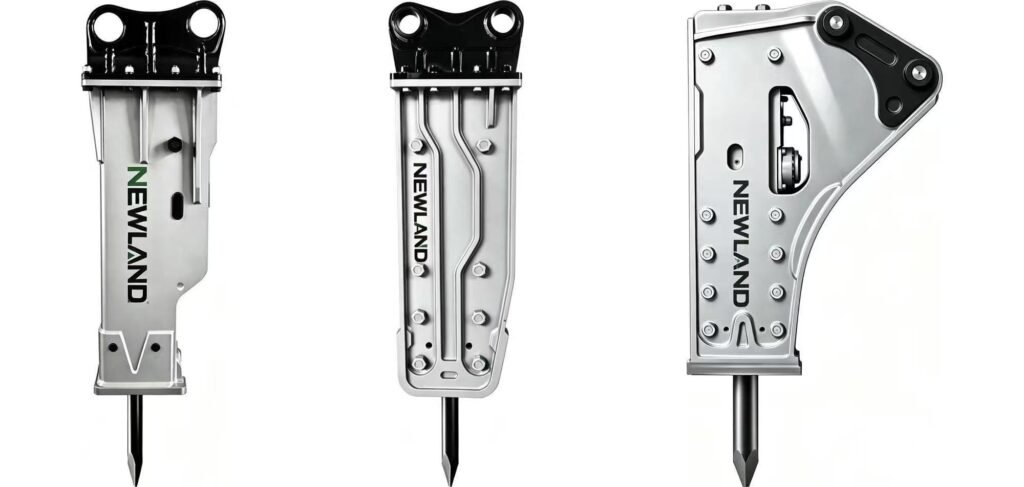
Start with the result the job needs
A hydraulic breaker applies repeated impacts through a working tool to fracture material. For selection purposes, the useful question is what the material must become: concrete broken free for removal, an oversize rock reduced to a specified size, or a trench formation brought to the required profile. These jobs impose different demands even when the same carrier is available.
Define the completion point before comparing breakers. “Break concrete” leaves open whether reinforcement must remain accessible, whether the broken material must fit a restricted opening, and how much adjacent structure must stay undisturbed. A clear end condition also makes later output records meaningful.
Match the description to the material
Record dimensions and visible condition rather than relying on a single label such as hard rock. Concrete may contain reinforcement or embedded services. Rock can be fractured or massive, confined or already separated into loose blocks. Pavement work may be restricted by an edge line and a surface that must remain intact.
| Task | Useful application detail | Selection question |
|---|---|---|
| Concrete removal | Thickness, reinforcement and retained edges | What access and working-tool arrangement can the task accept? |
| Loose rock reduction | Starting size and required final size | Can the block be positioned and reached consistently? |
| Trench or foundation work | Depth, width and surrounding ground | Can the complete attachment work within the available envelope? |
| Pavement breaking | Layer build-up and boundary limits | How will the required break line and finished area be defined? |
Check the work envelope as well as the breaker
Carrier access determines where the tool can be presented to the material. Include working height, reach, approach angle and obstructions in the brief. A narrow opening may restrict the housing and bracket before the tool reaches the target. A suitable nominal carrier category does not prove that the full assembly clears the structure.
Separate ordinary work from special conditions. Water exposure, confined access, temperature extremes and sensitive surroundings require their own review of the proposed configuration and work plan. They should appear as explicit requirements rather than being assumed covered by a general breaker description.
Avoid selecting by one impressive number
Carrier weight, tool diameter and impact figures each describe part of the system. None alone establishes the completed job rate. Hydraulic compatibility, mounting, tool choice and the material all influence the result. Higher figures on one line of a specification are not a substitute for a matched system.
For example, two hypothetical concrete jobs may have equal volume, while one is an open slab and the other is a reinforced wall beside a retained surface. Equal volume does not make their access, work sequence or expected output equivalent. This is an illustration of planning differences, not a statement of NEWLAND performance.
Turn the application into a selection brief
Use photographs with a scale reference, material dimensions, a description of the required result and the intended carrier. Add site restrictions and any special configuration requirements. These details allow the breaker range to be reviewed against the work instead of producing a recommendation from a broad industry label.
NEWLAND supplies new hydraulic breakers and breaker parts. Start with the hydraulic breaker range for product options, then use the selection guide to combine the application brief with carrier and mounting information. Production estimates should be developed separately from comparable, verified job records.
What does hydraulic road breaker mean in this guide?
In this guide, hydraulic road breaker and road hammer mean a carrier-mounted, piston-driven breaker that transmits impacts through a working tool. The name alone does not identify the required equipment. Include a photo or drawing of the proposed attachment and state whether the target is an asphalt layer, an underlying concrete layer or exposed rock. Use the material and boundary checks above to prepare the application brief, then review the matched breaker range before requesting a quotation.
carrier-mounted hydraulic breaker range · develop an output estimate from comparable job records