
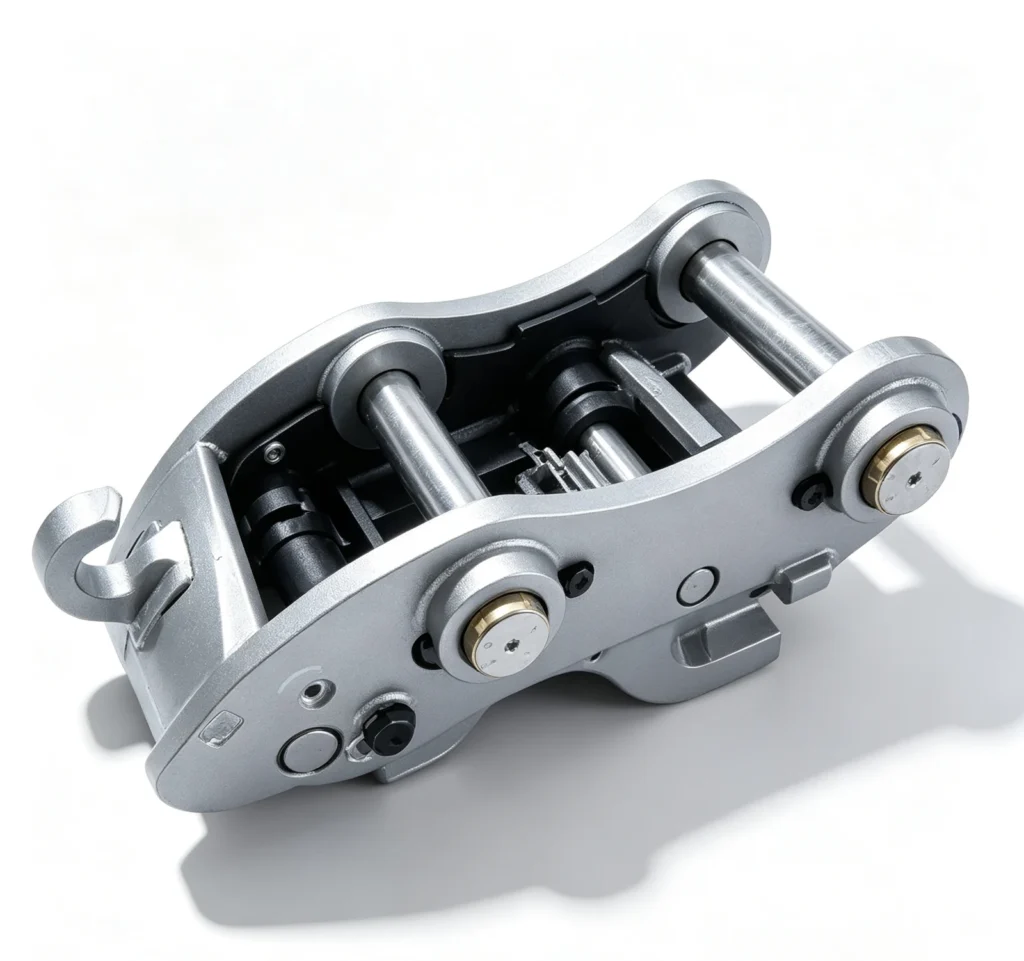
Identify which coupler you mean
The excavator quick coupler mechanically connects the attachment to the carrier. Hydraulic hose couplings connect the oil circuit. Both may be called a quick connector in conversation, but they fail in different ways and need different replacement parts.
Start by identifying the carrier-side coupler, the breaker bracket and the hose connection separately. A photograph of a hose fitting does not establish mechanical pin compatibility. Likewise, a breaker that sits in the bracket can still have an unsuitable hose or return-line arrangement.
A mechanical fit requires more than pin diameter
Pin centers, engagement width, bracket geometry and the coupler’s permitted attachment range all affect the connection. Worn pins, altered brackets or an undocumented adapter can change the fit. The coupler also changes attachment weight and the distance between the breaker and the carrier linkage.
Unexpected movement, incomplete indication or difficulty achieving the prescribed lock confirmation needs attention before work. Never substitute an improvised pin, bolt or wire for a specified retaining component. The fact that an attachment has remained connected during earlier work does not prove that its retention system is correct.
When a coupler has recently been replaced, compare the complete old and new configurations rather than only their nominal capacity. A different offset or engagement range can affect bracket clearance and hose movement even if the pin diameter remains the same. The review must also establish whether the fitted retaining parts belong to the new coupler. Reusing convenient components from an earlier installation is not evidence that the connection meets the new arrangement’s requirements.
| Problem area | What must be established |
|---|---|
| Attachment will not seat correctly | Approved pin geometry and engagement envelope |
| Lock indication is unclear | Correct model-specific confirmation and retention system |
| Unexpected attachment movement | Condition of coupler, bracket, pins and engagement surfaces |
| Breaker will not operate after coupling | Separate hydraulic connection and auxiliary-circuit review |
Hydraulic symptoms need their own checks
A mechanically secure attachment can still receive inadequate oil flow through an unsuitable or incompletely connected hose arrangement. Connection size, pressure rating, return-path requirements and routing must all match the specified system. Restricted connections may affect impact performance or create heat.
Do not operate through uncertain mechanical retention to investigate the hydraulic symptom. Once the attachment is made safe, an authorised technician can check the hose and circuit specification under the prescribed procedure. Changing a coupler does not automatically make an existing breaker setup hydraulically compatible.
Choose the replacement scope from the findings
A new coupler, a breaker bracket and replacement hose couplings are different purchase scopes. Confirm which assembly is needed and whether the existing mating components remain within their approved condition. Avoid requesting a universal coupler based only on the carrier weight class.
For NEWLAND supply, provide the connection drawing or verified dimensions, the carrier reference and the intended breaker configuration. The final configuration should include the applicable instructions and agreed retention components. Installation acceptance belongs to a competent person using those documents, rather than an assumption based on a successful pickup.