
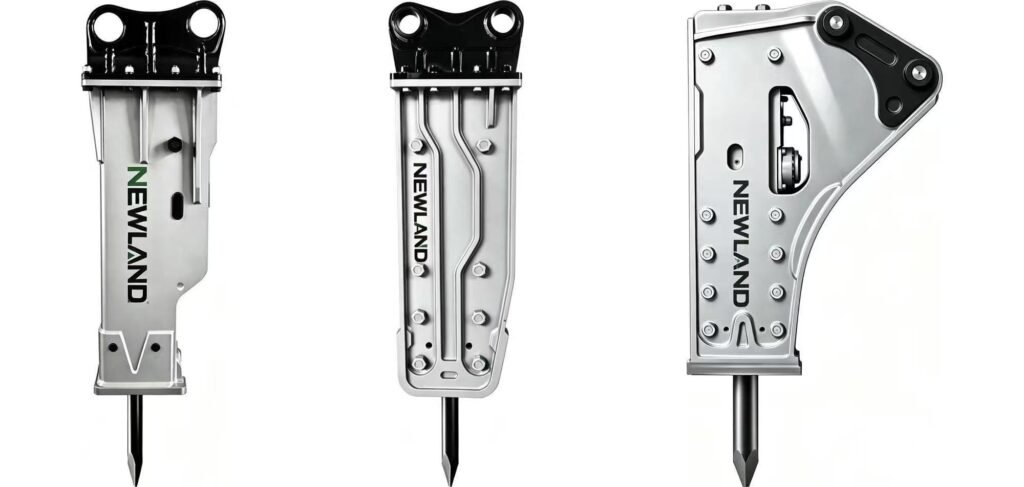
Use the type name to start the comparison
Box, side and top type hydraulic breakers are commonly distinguished by their housing and mounting layout. The names help organize a product range, but they do not establish a universal order of power, durability or suitability. Compare the actual proposed models and mounting configurations rather than choosing from the type label alone.
NEWLAND’s range includes all three layouts. A useful comparison begins with product images and drawings that identify the body enclosure, connection position and complete attachment dimensions. The drawing should show what the name means for that specific product, especially where commercial naming conventions differ.
Compare the features that affect your installation
Use complete attachment weight and dimensions, including the agreed tool and bracket. A comparison that includes the bracket for one type and excludes it for another is not comparing the same scope.
| Layout | Useful point to examine | Avoid assuming |
|---|---|---|
| Box type | Enclosure, complete envelope and the selected mounting arrangement | That the name alone proves a particular noise result |
| Side type | Side mounting geometry, width and connection clearances | That appearance establishes carrier compatibility |
| Top type | Upper connection arrangement and overall assembly position | That the type automatically provides greater output |
Let access and connection requirements narrow the choice
The job may impose a limited opening, a restricted working position or an existing coupler that the new breaker must use. These conditions can make housing and bracket geometry more relevant than a general preference for one layout. Check the proposed assembly through the carrier and mounting review.
Service access also deserves an explicit question. Identify how the relevant components are accessed under the applicable maintenance instructions rather than judging maintenance effort from an exterior photograph. A neat enclosure or visible fastener layout is not enough to predict actual service time.
Treat noise and performance as documented results
An enclosure description does not replace a noise statement with a defined measurement basis. Similarly, a type name cannot confirm impact energy, production rate or tool life. Those comparisons need model-specific information and equivalent conditions.
For a hypothetical purchasing exercise, two different layouts may both meet a carrier’s confirmed requirements. If one fits a restricted work envelope more easily, that is a meaningful application difference. It does not establish a general claim that the same layout is superior on every site.
Make a short, relevant selection record
List the requirements that actually distinguish the options: carrier match, connection reference, available space, complete attachment scope and any documented environmental requirement. Mark the type-independent requirements separately. Hydraulic supply, for example, still needs to match the chosen breaker regardless of its exterior layout.
Use the individual NEWLAND box, side and top type pages to review the supply options. Then compare the proposed models through one consistent checklist. The result should be a selected configuration with reasons tied to the job, rather than a choice based only on shape or a broad marketing description.