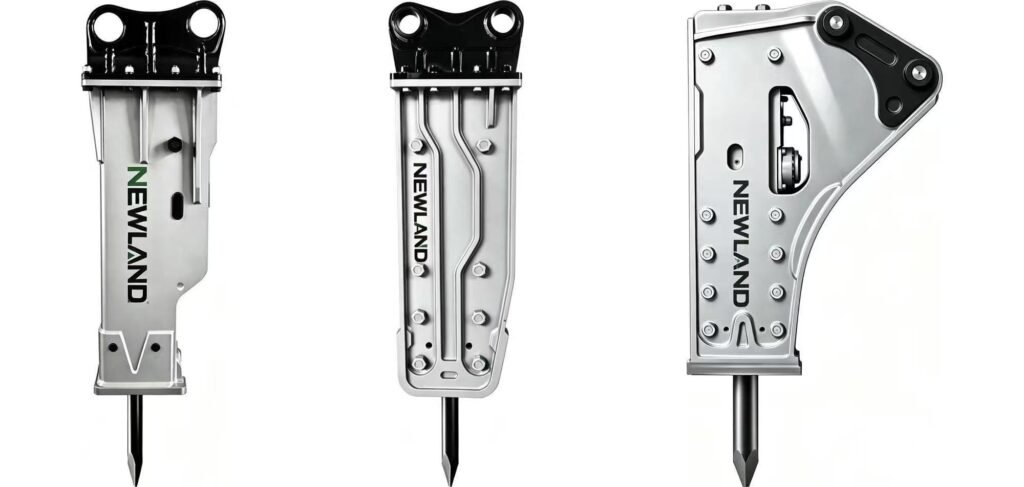
The NLB examples, carrier weight ranges and chisel diameters discussed here illustrate selected models only. Contact NEWLAND for other models and specifications.
A mini excavator breaker inquiry can contain many documents and still leave the purchasing decision unclear. The useful question is whether those records support the particular breaker and mounting proposal under discussion. This guide provides a decision framework for reviewing that proposal. It does not identify a universal breaker size or establish which NEWLAND models are available for a given carrier.
Separate an initial candidate from a reviewed proposal
A product suggested from a carrier description is a candidate. It becomes a reviewable proposal when its identity, relevant documents and mounting scope are connected to the actual machine and application. Keep that distinction visible throughout the conversation.
A familiar carrier class or a similar product photograph cannot close the decision on its own. Our existing article on breaker sizing and carrier weight explains which records to collect. This article begins after that collection: it asks how to classify the evidence, handle unresolved differences and decide what the purchasing team can review next.
Assign one of three decision statuses
Use a status for each review area before assigning an overall status. This prevents a complete commercial offer from hiding a missing technical record, or an identified bracket from being mistaken for confirmation of the whole combination.
| Status | Meaning | Next decision |
|---|---|---|
| Not yet confirmed | Relevant evidence is missing or has not been connected to the proposed combination. | Keep the candidate provisional and identify the missing basis. |
| Needs clarification | Information is available, but its meaning, applicability or consistency remains unresolved. | Request a specific answer or revised document before proceeding. |
| Ready for quotation review | The proposal is identified and sufficiently clear for a commercial review, with remaining conditions explicitly recorded. | Review the offer against that configuration and its stated conditions. |
“Ready for quotation review” does not mean ready to install or operate. Final compatibility questions still need to be resolved before the purchasing decision, using the relevant machine records and confirmed product information.
Review the interfaces as one connected decision
Assess carrier limits, hydraulic compatibility and mechanical mounting as connected parts of the proposal. A positive answer in one area does not settle the others. For example, a documented mounting arrangement does not establish that the available auxiliary circuit satisfies the proposed breaker’s requirements.
Check whether the hydraulic records refer to the actual machine configuration and whether the proposal identifies the product requirements being compared. If the records have different labels or unclear applicability, use “needs clarification”; do not interpret the difference yourself.
For mounting, ask whether the reviewed arrangement is direct or includes an existing quick coupler, and whether the documents describe that same arrangement. Use the quick coupler compatibility checklist for that interface. Keep any installation or setting questions with the appropriate technical reviewer; this purchasing framework provides no adjustment or operating instructions.
Apply the same rules to two illustrative proposals
The comparison below is invented to show the review logic. A and B are proposal labels, not real products or model names. It contains no product recommendation.
| Evidence question | Proposal A | Proposal B |
|---|---|---|
| Is the proposed breaker identified? | Reference and document version linked. | General product description only. |
| Do the hydraulic records apply to this machine? | Applicability recorded for review. | Source and applicability unclear. |
| Is the mounting scope consistent? | Arrangement identified; open checks listed. | Photograph supplied; arrangement unspecified. |
| What is the next action? | Review the stated offer and its recorded conditions. | Clarify the product, records and mounting proposal. |
Proposal A may be ready for quotation review because its scope can be examined. It still requires the appropriate compatibility decision. Proposal B is not necessarily unsuitable; it is insufficiently defined. A lower price or more confident description would not resolve those evidence gaps.
Record the decision before the proposal changes
Use a short decision record rather than another unstructured attachment list. For each review area, record:
- The exact proposal and document version being assessed.
- The status: not yet confirmed, needs clarification or ready for quotation review.
- The unresolved question and the evidence needed to answer it.
- The person or team responsible for the review.
- Whether a proposed change requires the decision to be reopened.
A different bracket, mounting route or product reference can change the basis of the review. Return to the affected questions instead of carrying an earlier conclusion onto the revised proposal. Keep the commercial offer connected to the same version.
Move to a focused quotation review
Use the hydraulic breaker selection guide if the application or carrier requirement is still unclear. When you have an identified candidate and a clear record of open questions, ask NEWLAND to review your mini excavator breaker inquiry. Any proposed model, availability and compatibility remain subject to the actual inquiry; this guide makes no claim about an unconfirmed carrier range.
Continue with the relevant product or guide
How to Choose a Hydraulic Breaker
Hydraulic Breaker Sizing: Why Excavator Weight Is Only the Starting Point
Choosing a Hydraulic Breaker for a Skid Steer
Compare four NLB candidates for smaller excavators
NLB40, NLB45, NLB53 and NLB68 have listed carrier ranges ending at 2.5, 3.0, 4.5 and 7 Ton respectively. These are catalog screening ranges, rather than a guarantee that any carrier within a range can run that breaker. Check the actual excavator circuit and attachment limit.
NLB53 and NLB68 overlap from 4 to 4.5 Ton, but their listed oil flow requirements are 25–50 and 40–70 L/min. Their product pages show the remaining parameters and explain the mounting and tool details to provide when requesting a matched quotation.