
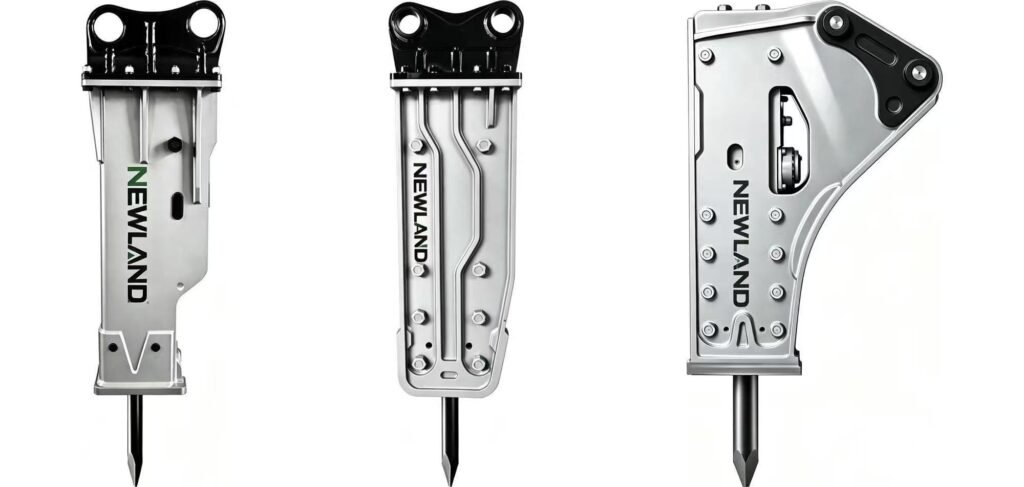
Store a known condition, not an unresolved fault
Complete the relevant inspection before storage and record any defect that remains open. A breaker removed because of leakage, poor output or a retention problem should not reappear months later as ready to fit simply because the symptom is no longer visible.
Keep the breaker reference, tool condition and mounting configuration with the storage record. Where parts have been removed, identify them and their location. This prevents an incomplete assembly from being mistaken for a complete attachment when work resumes.
Control stability, dirt and moisture
Use a suitable support arrangement and the specified storage orientation. An improvised stand may not control the attachment’s center of gravity or prevent movement if it is struck. Keep the unit where it can be accessed without placing people beneath suspended equipment.
Protect hydraulic connection interfaces with the correct clean closures and preserve exposed surfaces as directed. Open ports, dirty hose ends and standing moisture create risks that may become apparent only after reconnection. Covering the outside of the breaker does not protect an unsealed internal fluid path.
| Storage risk | What the storage plan should address |
|---|---|
| Instability or accidental movement | Suitable support, location and handling arrangement |
| Contamination at connections | Clean, compatible closures and protected hose ends |
| Corrosion or surface damage | Specified preservation and suitable environment |
| Lost identification | Model, configuration, condition and removed-part records |
| Uncertain readiness | Defined inspection and restart responsibility |
Preservation actions are model dependent
Tool handling, lubricant application, piston position and gas-system treatment can have specific requirements. Do not assume that every breaker should be charged, discharged, dismantled or periodically operated during storage. An unsuitable preservation method can create a problem instead of preventing one.
If a long storage period or harsh environment is planned, obtain the applicable preservation guidance before the unit is parked. Record what was done and when. Use the required lubricant and corrosion protection rather than combining unknown products on seals or precision surfaces.
Consider a unit stored with its bracket removed and hoses disconnected. On restart, the job is not simply to uncover the breaker and start work: the assembly identity, protected connections, missing components and new installation all need to be established. A storage record listing the removed items and preservation actions prevents guesswork. It also helps distinguish deterioration during inactivity from a fault that was already present when the attachment entered storage.
Restart as a changed equipment condition
Before refitting, review the storage history and any unresolved defect. A competent person should assess the visible condition, connections, tool and retained components under the appropriate procedure. The carrier and mounting configuration may also have changed since the breaker was last used.
Return to work requires the prescribed installation and acceptance checks, including any model-specific service requirements. Storage time alone does not provide a universal oil, seal or gas replacement schedule. If replacement parts are required, use the current drawing and component reference rather than relying on a description written before the unit was stored.
Related products and guides
Hydraulic Breaker Storage Stands
Hydraulic Breaker Pre-Operation Checklist: What to Confirm Before Work
Installing a Hydraulic Breaker: Mounting, Hose Identification and Handover Checks
Hydraulic Breaker Maintenance Records: A Practical Checklist
Hydraulic Breaker Service Life: Why Wear Develops and What to Track
Hydraulic Breaker Operation in Cold and Hot Weather