
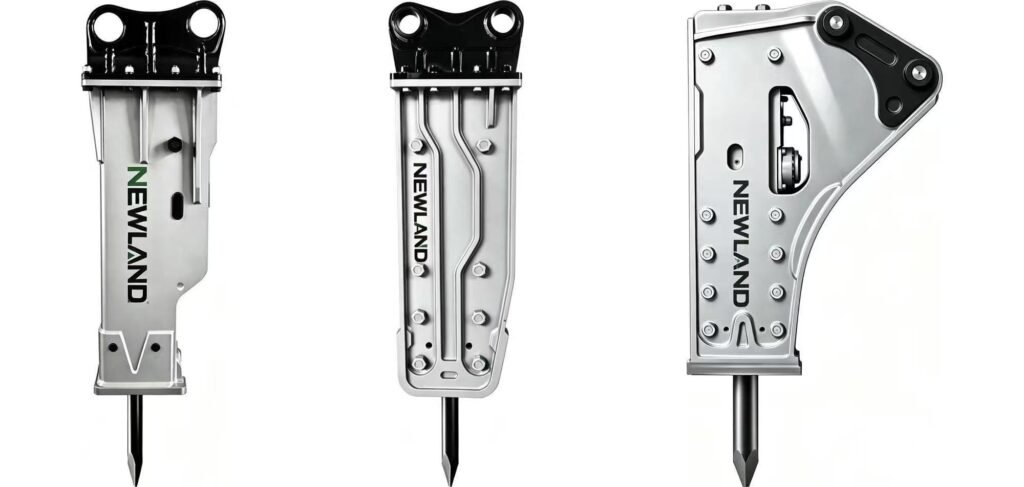
Breaker, hammer and working tool
Hydraulic breaker, hydraulic hammer and rock breaker commonly refer to the attachment that delivers repeated impacts. The working tool is the component that contacts the material and receives the piston blow. Commercial descriptions may call it a chisel, rod or bit, but those words do not identify its exact geometry.
Be explicit about whether the inquiry concerns the complete breaker or only its working tool. A request for a “hammer chisel” can be understood differently from a request for a complete hydraulic hammer package. The item reference and scope remove that ambiguity.
Main components and assembly names
Names alone do not establish what is included in a supplied assembly. One quotation may refer to a bare component while another includes additional internal items. Ask for an included-parts list when the scope affects the comparison.
| Term | Buying-context meaning |
|---|---|
| Main body | A body or assembly description whose included components must be defined |
| Cylinder | The component associated with guiding the piston and the relevant hydraulic spaces |
| Piston | The moving component that delivers the blow to the tool |
| Front head | The front-end component or assembly identified in the parts record |
| Back head | The rear or upper head component identified by the particular design |
| Housing | The exterior enclosure or support structure, distinguished from internal components |
Tool guidance, retention and fastening
Bushings guide the working tool within the relevant front-end arrangement. Rod pins or tool retainers are associated with retaining the tool. Through bolts connect major breaker sections in designs using that arrangement. These are separate ordering categories even when they appear close together in a photograph.
A component’s position matters. “Front bushing” and “lower bushing” may be interpreted differently unless the drawing identifies the location. Use a labeled parts image or an approved reference to connect the term with the actual item. Do not assume that a retaining pin is a mounting pin.
Carrier, bracket and quick coupler
The carrier is the machine providing the attachment connection and hydraulic supply. The bracket or adapter connects the breaker to the proposed mounting arrangement. A mechanical quick coupler allows an attachment connection to be changed through its designed engagement and locking system.
A hydraulic hose quick-disconnect is a fluid connection, not the same product as the mechanical excavator quick coupler. In an inquiry that includes both, label them separately. Likewise, identify whether mounting dimensions refer to the carrier, coupler or breaker side of the assembly.
Weight, flow, pressure and impact terms
Complete attachment weight includes the components defined in the stated scope; a bare-body weight may exclude them. Flow is oil volume per unit of time, while pressure describes a circuit condition or limit under its stated definition. Impact rate describes blow frequency; impact-energy statements require a clear basis for comparison.
These terms answer different questions. A single large figure does not establish compatibility or completed output. Keep units and document conditions with each value. NEWLAND’s hydraulic and specification guides explain those distinctions in more detail, while the parts-identification guide helps turn a component name into a precise purchasing reference.
Related products and guides
How Does a Hydraulic Breaker Work? Main Components and the Impact Cycle
Hydraulic Breaker Parts
Hydraulic Breaker Chisel Identification: Photos and Measurements to Send
Hydraulic Breaker Parts or Assembly? Define What Your Quotation Includes
Hydraulic Breaker Flow, Pressure and Return Line Requirements
Hydraulic Breaker Impact, Power and Specification Terms Explained