
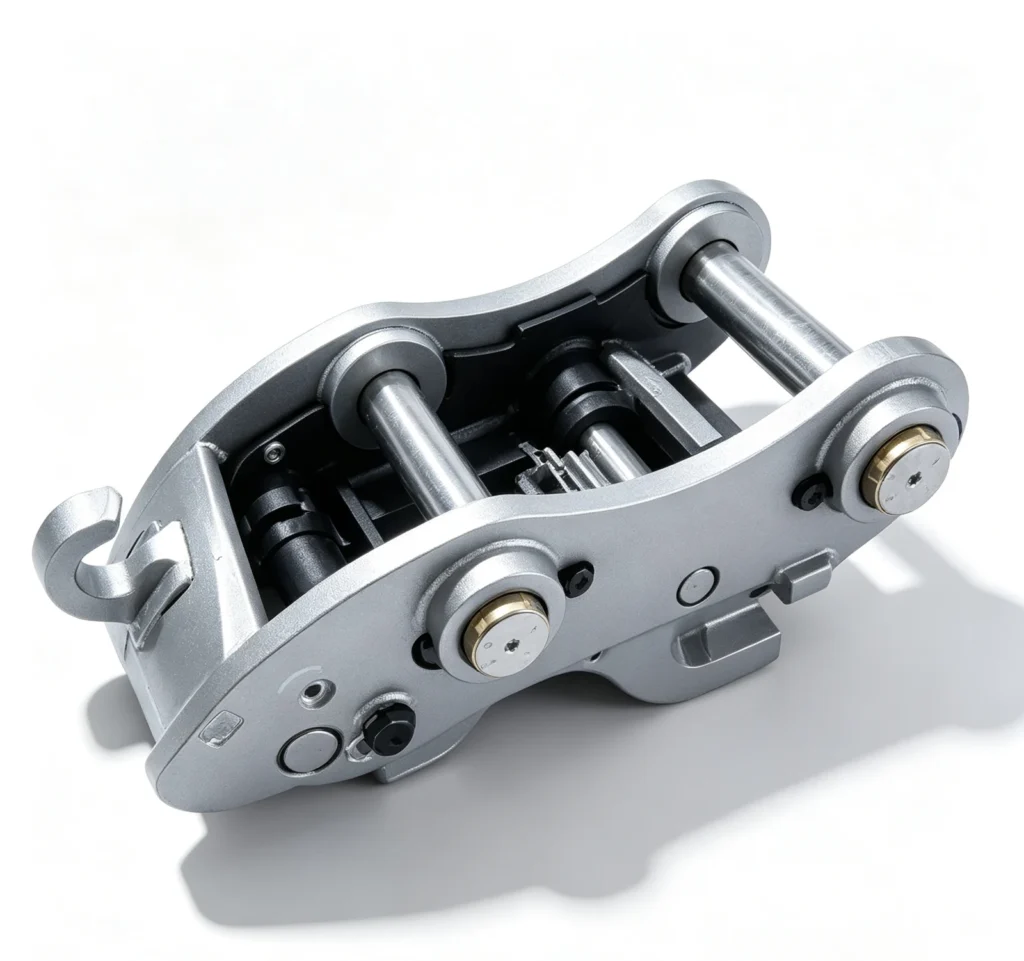
Actuation and retention are different questions
Manual actuation generally requires an operator action at the coupler, while hydraulic actuation uses a hydraulic mechanism. The detailed locking arrangement varies by design. Some systems have additional retaining components or other safeguards, so terms such as hydraulic or automatic must not be treated as a full description of the safety system.
Ask how the proposed model secures the attachment, how the operator confirms engagement and what happens when actuation pressure is lost. Use the actual product documentation. Do not assume that a cab switch or an indicator removes every ground-level task or inspection requirement.
Compare the whole installed configuration
For either type, verify pin diameter, center spacing, engagement width and bracket clearances. Confirm the permissible attachment range and the carrier’s approved arrangement. Coupler mass and added offset must be included when evaluating the breaker installation.
A hydraulic model also needs the correct actuation circuit and controls. Those requirements are separate from the breaker oil supply. The installation must prevent confusion between the coupler control and attachment operating functions; a generic hose diagram is not an adequate substitute for the specified arrangement.
| Selection question | Manual actuation | Hydraulic actuation |
|---|---|---|
| How is the lock operated? | A model-specific manual procedure | A model-specific hydraulic/control procedure |
| What confirms retention? | The specified inspection and confirmation method | The specified indication and confirmation method |
| What carrier provision is needed? | Approved mechanical interface and access | Approved interface plus required controls and circuit |
| Does the name prove compatibility? | No; check the actual interface | No; check the actual interface |
Frequency of changes is only one part of the decision
A site that changes attachments frequently may value a suitable hydraulic arrangement, but change time should be considered with access, training and inspection requirements. A simpler manual arrangement may suit another application if the approved procedure can be followed safely and consistently.
The right choice is the one whose connection procedure, maintenance requirements and carrier integration fit the actual work. Do not calculate savings by assuming that any attachment can be connected without confirmation or that people can remain inside the operating area during a change.
For instance, an operator changing tools in a confined work area still needs a controlled attachment-change location and adequate visibility, whichever actuation method is selected. Hydraulic operation can change the tasks involved, but it does not remove the need to know that the specified retention system is engaged. Compare the actual procedure in the intended environment before deciding that a faster advertised change automatically gives a better operating arrangement.
What to specify when ordering from NEWLAND
State the carrier reference, intended breaker and bracket dimensions, preferred actuation type and required documentation. Ask the quotation to identify the exact coupler configuration and included components. If there are additional retaining parts, controls or installation items, their supply responsibility should be explicit.
Once installed, the system must be commissioned and used by competent personnel following its instructions. A coupler selection article cannot supply a universal unlocking, locking or retention-test sequence. Keep the correct instructions with the carrier so that a change of operator does not become a change in connection practice.
Related products and guides
Excavator Quick Couplers
Quick Coupler Compatibility: A Measurement Checklist Before You Order
Hydraulic Breaker Quick Coupler Problems: Describe the Connection Before Inspection
Using a Hydraulic Breaker with a Quick Coupler: What to Confirm Before Ordering
Quick Couplers for Skid Steer Breaker Setups