
Identify the rear attachment arrangement
A hydraulic breaker for a backhoe is selected against the rear working equipment and its approved attachment requirements. Start with the exact machine identification and rear-arm configuration. A description of the whole machine does not necessarily identify the attachment interface or the auxiliary circuit fitted to that particular unit.
Record any quick coupler, adapter or other connection component that will remain in use. A breaker offered with a bracket for a direct pin connection should not be assumed to match an existing coupler. The review needs the final arrangement, including components that are not being purchased from the breaker supplier.
Review complete attachment weight and geometry
The breaker, working tool, mounting bracket and coupler form the complete attachment. Use the applicable carrier information to review that assembly. Whole-machine operating weight is not a substitute for the rear attachment limits or the constraints of the intended working position.
The geometry also matters. The proposed bracket and any adapter affect where the breaker sits relative to the arm and linkage. Working clearance should be checked over the intended movement envelope through the appropriate installation review, rather than at only one convenient parked position.
| Matching area | Backhoe-specific record |
|---|---|
| Rear working equipment | Arm configuration and applicable attachment information |
| Connection | Pin or coupler reference and any adapter arrangement |
| Hydraulics | Installed auxiliary circuit and return-line information |
| Assembly | Complete supplied and retained components |
| Application | Required reach, access and intended working task |
Confirm the attachment circuit rather than the machine headline
Obtain the auxiliary hydraulic information for the rear attachment connection. The relevant data includes available flow, pressure terminology and the approved return arrangement. A general pump-output figure does not establish the conditions at the attachment, and an existing pair of hoses does not prove suitability.
If the breaker or circuit requires a particular control function, that requirement must be reviewed with the installed machine configuration. Qualified personnel should handle testing and commissioning using the applicable procedures. There is no universal pressure or flow setting that can be inferred from the word backhoe.
Avoid copying a previous match without checking the interfaces
A hypothetical buyer might transfer a breaker from one backhoe to another with a similar machine size. The tool and body remain the same, but the pin arrangement, coupler or circuit can differ. Similar size therefore supports only an initial comparison; it does not transfer the earlier compatibility decision.
Use labeled photographs to establish orientation and a drawing to establish the dimensions. Make clear whether a measurement describes the carrier, coupler or breaker bracket. Combining measurements from different interfaces can produce a drawing that describes no actual connection.
Define the package before comparing quotations
A matching request should identify what will be reused and what needs supply. Ask the quotation to distinguish the breaker, bracket, tool and connection items. Keep any open carrier or installation question visible until the proposed combination has been reviewed.
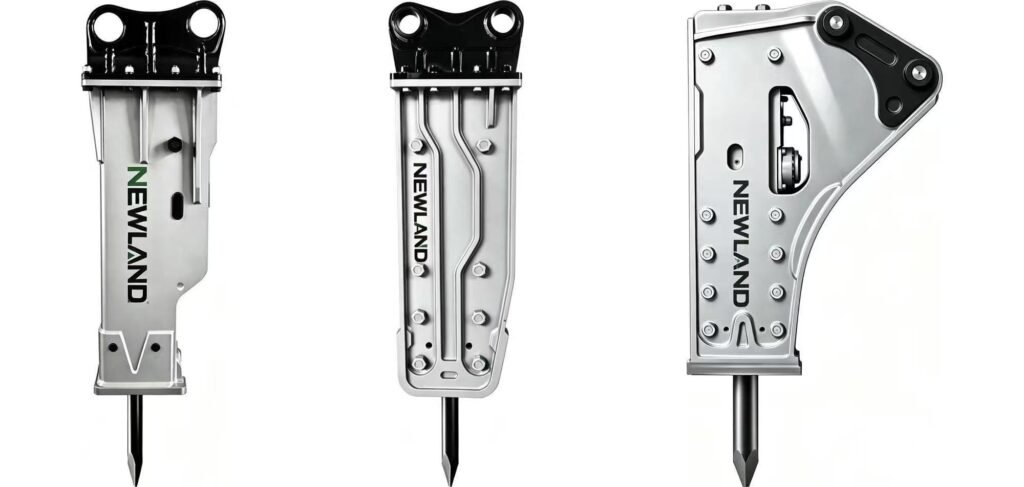
NEWLAND’s backhoe breaker product page provides the commercial starting point. Pair it with the general compatibility and mounting guides to prepare a complete inquiry. The final order should retain the agreed carrier and assembly reference so future parts requests refer to the same configuration.
Related products and guides
Hydraulic Breakers for Backhoes
Hydraulic Breaker Compatibility Checklist: Carrier, Oil Circuit and Mounting
Hydraulic Breaker Mounting Dimensions: What to Measure Before Ordering
Hydraulic Breaker Flow, Pressure and Return Line Requirements
How to Choose a Hydraulic Breaker
Large Hydraulic Breakers