
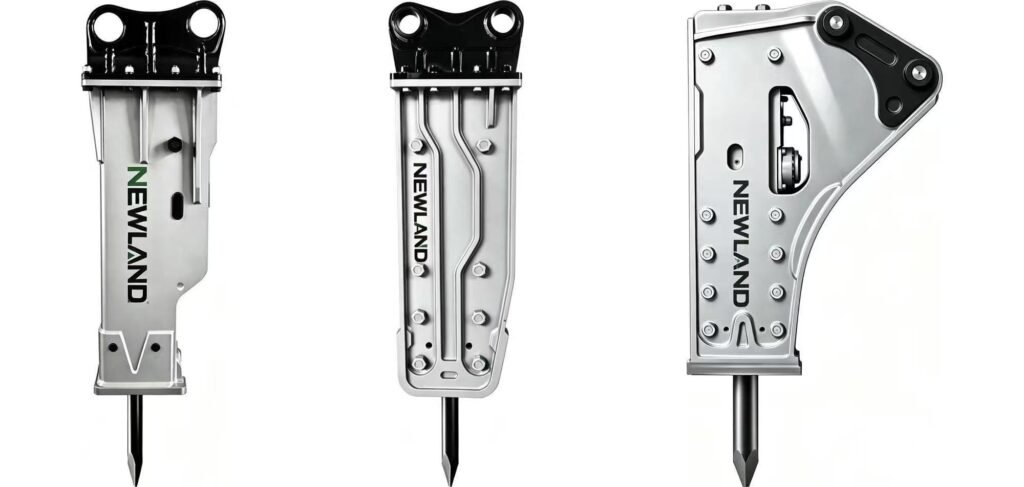
The NLB examples, carrier weight ranges and chisel diameters discussed here illustrate selected models only. Contact NEWLAND for other models and specifications.
Weight class is a starting point, not complete compatibility
A suggested carrier range helps narrow the selection, but actual installed mass also depends on the bracket, coupler and working tool. Compare the complete attachment package with the carrier’s permitted arrangement, including the working reach and mounting geometry.
Tool diameter is another useful identification field, but two breakers with a similar diameter need not share the same hydraulic requirements, internal design or output. A model name or nominal class should not replace the complete technical table.
Energy, force and frequency answer different questions
Impact energy describes energy associated with an individual blow and is commonly stated in joules. Blow frequency describes how often impacts occur. Neither is the same as peak impact force, which depends on how the impact develops through the tool and material over time.
Multiplying energy per blow by blows per second gives a nominal impact-power relationship when the values describe the same operating point and measurement basis. It does not account for every transmission loss or predict production in a particular rock. Avoid combining the highest energy and highest frequency from different operating conditions.
| Specification | What it describes | Common comparison error |
|---|---|---|
| Operating weight | Mass in a stated configuration | Omitting bracket or coupler mass |
| Impact energy | Energy associated with one blow | Calling it force without a time or deformation basis |
| Blow frequency | Impacts per unit of time | Assuming more blows always means more useful output |
| Hydraulic input power | Power available from pressure difference and flow | Treating it as delivered impact power |
Hydraulic input power is not a guaranteed output
Flow and the pressure difference across the attachment define hydraulic input power. The breaker converts only part of that input into useful impacts; other energy is dissipated through hydraulic and mechanical losses. Carrier engine power is a further step removed and does not establish attachment delivery.
Confirm whether a stated pressure is an operating requirement, a supply limit, a return restriction or a relief setting. They serve different purposes. Similarly, maximum pump flow is not necessarily the controlled auxiliary flow available to the breaker under working conditions.
Suppose a carrier specification lists its maximum pump output, while the breaker proposal lists an allowed auxiliary-flow range. Those figures cannot be compared as if all pump output reaches the breaker continuously. The carrier’s configured attachment circuit and working conditions determine the relevant delivery. Confirm that operating point before comparing headline impact figures, because a technically capable breaker cannot deliver its intended behavior from an unsuitable supply arrangement.
Compare the same units and the same test basis
Ask how impact energy or any advertised impact class was determined. A marketing class is not automatically a standardised value that can be converted to joules. Where methods or test conditions differ, the figures may not support a direct ranking.
For a NEWLAND selection, request the specification for the actual proposed model and configuration. Compare carrier compatibility, working tool and application before focusing on one headline number. There is no universal best power rating: the suitable choice must operate within the approved carrier circuit and match the material, access and required fragment size.
Read a real NLB specification without combining different fields
NLB120 lists 115–150 L/min required oil flow, 160–180 bar operating pressure and 210 bar setting pressure. NLB125 lists 90–120 L/min, 150–170 bar and 210 bar respectively. Keeping these fields separate reveals differences that a shared carrier range would miss.
The NLB120 and NLB125 product pages also show impact energy in joules, impact rate in blows per minute, tool diameter and series reference weight. A larger model number does not guarantee a higher value in every field. Use the exact specification, then confirm the complete quoted assembly.
Related products and guides
Hydraulic Breakers
Hydraulic Breaker Flow, Pressure and Return Line Requirements
How to Choose a Hydraulic Breaker
How Does a Hydraulic Breaker Work? Main Components and the Impact Cycle
Hydraulic Breaker Terminology: A Buyer’s Glossary
Hydraulic Breaker Noise Levels: What the Figures Mean Before You Buy