
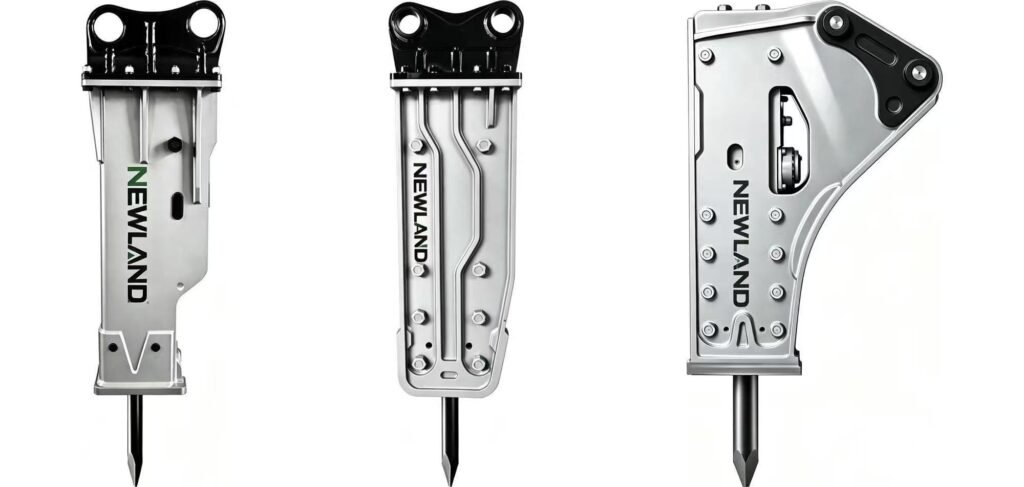
Identify what differs from the standard arrangement
Describe the carrier, linkage and any coupler or adapter between the machine and breaker. Identify which components have changed and who supplied or approved the alteration. A familiar machine model does not establish that its present attachment arrangement is unchanged.
Keep the breaker configuration equally clear. Bracket, coupler and tool mass contribute to the installed load and offset. The review must use the complete assembly rather than the bare breaker weight or a nominal product class.
Reach and offset change the mechanical question
Moving the attachment farther from the original linkage changes its geometry and the loads associated with its position. It can also affect the ability to maintain the intended tool alignment. Clearances must be considered through the approved operating envelope, not only in a parked pose.
Pin diameter, center spacing and engagement width still matter, but they do not resolve structural suitability or carrier stability. An adapter that makes the parts physically connect cannot by itself establish that the system is approved for impact work.
For example, retaining the same breaker while adding an adapter may seem less significant than changing the attachment. In practice the new assembly can have a different offset, hose path and clearance envelope. Those changes need to be reviewed against the approved carrier arrangement. Do not use a successful low-load movement as proof of suitability for repeated impacts, and do not resolve an uncertain mechanical approval by selecting a lower auxiliary setting.
| Changed element | Matching question |
|---|---|
| Linkage or reach | What attachment load and operating envelope are approved? |
| Coupler or adapter | What mass, offset, geometry and retention arrangement are added? |
| Auxiliary circuit | What controlled delivery and return requirements are verified? |
| Controls or routing | Are functions identified and hoses suitable through movement? |
| Application environment | Does the proposed model include the required special configuration? |
Review the actual hydraulic delivery
A nonstandard auxiliary system needs its own verified requirements and measurements. Available flow at the attachment, relevant pressure conditions and the return path must suit the proposed breaker. A pump’s maximum capacity does not prove that the modified system delivers an acceptable operating condition.
Hose size, connection arrangement and any additional drain or control line must also match the configuration. Do not adapt a port or change settings by trial to make a breaker cycle. The installation needs a competent technical review and the corresponding acceptance process.
Turn the review into an orderable configuration
Provide the actual drawings or verified interface information, the carrier’s approved attachment requirements and the intended work. Resolve open questions before finalising the breaker, bracket and hose scope. Where an approval or technical assessment is needed, make its responsibility explicit.
NEWLAND can review a defined new breaker and associated product requirement for the special setup. The final quotation should identify the supplied configuration and the information on which the match depends. Installation and operating acceptance must be completed for the actual assembly; it cannot be inferred from experience with a standard machine.